
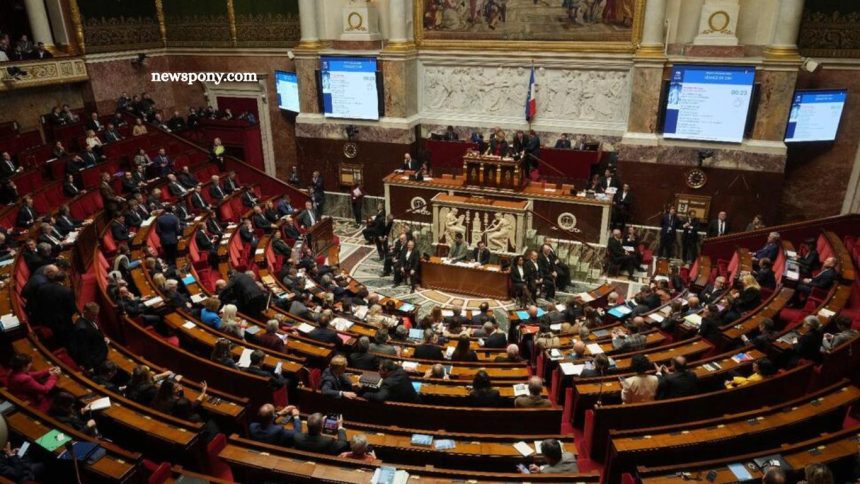
PARIS France’s deeply divided parliament has approved an emergency funding law aimed at preventing a government shutdown, as political deadlock over the 2026 national budget threatens to push the country into a fresh institutional crisis. The measure, passed just days before the end of the year, allows the government to continue collecting taxes and funding public services while lawmakers attempt to negotiate a full budget.
The emergency legislation comes after weeks of failed negotiations and highlights the growing instability facing President Emmanuel Macron’s minority government. With no agreed budget in place and political factions entrenched in opposing positions, the temporary law is designed to keep the state functioning and avert the kind of shutdowns that periodically paralyze the U.S. federal government.
Emergency Measure Passed Under Pressure
The bill was approved Tuesday evening by the National Assembly, France’s powerful lower house, following intense debate and multiple amendments. The Senate later gave its approval, clearing the final legislative hurdle. Despite fierce opposition and ideological rifts, lawmakers agreed that allowing the government to grind to a halt was not an option.
The emergency law authorizes the state to operate using tax and spending levels based on the 2025 budget. This ensures that salaries for public employees, pensions, welfare payments, and funding for local governments continue uninterrupted in the absence of a new fiscal framework.
Government officials stressed that the bill is strictly temporary and does not replace a full budget. Instead, it serves as a stopgap measure designed to preserve economic stability while negotiations resume.
Read More: Lucy Powell Urges Labour to Uphold Manifesto on EU Customs Union, Implicitly Criticizing Streeting
Macron’s Cabinet Moves Quickly
President Macron convened an emergency Cabinet meeting late Monday night to finalize the draft law before presenting it to parliament. Officials described the move as essential to safeguarding “the continuity of national life” and maintaining public services.
The urgency reflects mounting concern within the government over the economic and political consequences of prolonged uncertainty. France, the eurozone’s second-largest economy, cannot afford a disruption in state operations at a time when investor confidence is already fragile.
Cabinet members emphasized that failure to pass the bill would have triggered immediate disruptions, including delayed payments to local authorities and uncertainty for millions of citizens who rely on state support.
A Fractured Parliament
The vote exposed the deep divisions within France’s political landscape. The National Assembly is split among three major blocs: Marine Le Pen’s far-right National Rally, a broad coalition of left-wing parties, and Macron’s centrist alliance, which lacks an outright majority.
Each camp holds sharply different views on taxation, public spending, and economic reform. While many lawmakers criticized the government for failing to secure a full budget, most ultimately backed the emergency law to avoid a constitutional and economic crisis.
Far-right and left-wing lawmakers used the debate to attack Macron’s fiscal strategy, accusing his government of mismanagement and austerity. Supporters of the president countered that political obstruction and electoral calculations had made compromise nearly impossible.
“A Spare Tire, Not a Solution”
Finance Minister Roland Lescure described the emergency law as a temporary safeguard rather than a long-term fix. Speaking to lawmakers, he compared the measure to a “spare tire,” warning that relying on it for too long would weaken the economy and undermine France’s credibility with investors.
Lescure urged parliament to resume serious budget negotiations immediately, stressing that prolonged uncertainty could lead to higher borrowing costs and reduced growth. France already carries one of the largest public deficits in the European Union, and pressure from financial markets is mounting.
The government aims to reduce the deficit to 5% of gross domestic product, a target that remains challenging given political resistance to spending cuts and tax increases.
Economic Challenges and Rising Deficit
France’s fiscal problems are rooted in a long-standing imbalance between spending and revenue. The country maintains one of Europe’s most generous social welfare systems, with high expenditures on health care, education, pensions, and unemployment benefits.
While taxes are among the highest in the developed world, they have not been sufficient to offset rising costs, particularly as economic growth has slowed. Inflation, higher interest rates, and sluggish productivity have added further strain to public finances.
Economists warn that without structural reforms, France risks falling further behind its European peers. Credit rating agencies have already expressed concern over the country’s debt trajectory, raising the prospect of future downgrades.
Political Fallout From Snap Elections
Much of the current paralysis can be traced back to President Macron’s decision to call snap parliamentary elections last year. Intended to break legislative gridlock, the move instead produced a fragmented assembly and weakened the president’s authority.
The elections strengthened the far right and empowered left-wing coalitions, leaving Macron’s centrists without a clear governing majority. Since then, passing major legislation has required fragile alliances and last-minute compromises.
The collapse of budget talks for 2026 underscores the limits of this approach. What was meant to restore stability has instead prolonged political uncertainty, complicating efforts to address France’s economic challenges.
Prime Minister Calls for Holiday Negotiations
Prime Minister Sébastien Lecornu, who resigned earlier in the year before being reappointed in the fall, appealed to lawmakers across the political spectrum to continue negotiations through the holiday period.
Speaking after the vote, Lecornu urged parties to set aside ideological differences and focus on the national interest. He warned that failure to reach a budget agreement would expose France to renewed political turmoil early next year.
Lecornu’s minority government has survived several confidence tests but remains vulnerable. Each major policy initiative risks triggering new confrontations in parliament.
Recent Legislative Battles
Earlier this month, the government secured a narrow victory when parliament approved a key health care budget bill. The win provided temporary relief but came at a high political cost.
To secure support, the government agreed to suspend Macron’s controversial pension reform, which aimed to raise the retirement age from 62 to 64. The reform had sparked mass protests and strikes, becoming one of the most divisive issues of Macron’s presidency.
The concession highlighted the government’s weakened position and its reliance on tactical compromises to remain in power.
Investor Confidence at Stake
Financial markets are closely watching developments in Paris. Investors have grown increasingly cautious amid repeated political crises and the absence of a clear fiscal roadmap.
Any prolonged reliance on emergency funding measures could push borrowing costs higher and further strain public finances. Analysts warn that France’s ability to meet its deficit targets depends on swift and credible action in the coming months.
European Union officials have also urged France to bring its finances under control, noting that sustained overspending could complicate broader efforts to stabilize the eurozone economy.
What Comes Next
The passage of the emergency law buys the government time, but it does not resolve the underlying issues. Negotiating a comprehensive 2026 budget will require compromises that have so far proved elusive.
Lawmakers must agree on how to balance spending cuts, tax policies, and economic reforms in a political environment defined by mistrust and rivalry. Failure to do so could trigger another crisis, including the possibility of a no-confidence vote or renewed calls for elections.
For now, France has avoided the immediate shock of a government shutdown. Whether it can escape a longer-term political and fiscal reckoning remains uncertain.
As the new year approaches, pressure is mounting on President Macron and parliament alike to deliver stability — not just emergency fixes to a nation weary of political deadlock.
Frequently Asked Questions
Why did France pass an emergency budget law?
France approved the emergency law to prevent a government shutdown after talks on the 2026 budget failed.
What does the emergency law allow the government to do?
The law allows France to collect taxes and fund public services using 2025 budget levels temporarily.
Which political groups supported or opposed the bill?
The bill passed despite divisions among Macron’s centrist government, the far-right National Rally, and left-wing parties.
Does the emergency law replace the 2026 national budget?
No, the law is a temporary measure and does not replace the need for a full 2026 budget agreement.
What economic challenges is France currently facing?
France is struggling with a high public deficit, rising debt, heavy social spending, and weakened investor confidence.
How has President Macron’s leadership affected the crisis?
Snap elections weakened Macron’s majority, creating a fragmented parliament and making budget negotiations more difficult.
What happens if lawmakers fail to agree on a full budget?
Failure to pass a full budget could trigger renewed political instability, financial market pressure, and another crisis.
Conclusion
France’s approval of an emergency funding law has successfully averted an immediate government shutdown, but it underscores deeper political and fiscal challenges facing the country. The temporary measure ensures continuity of public services, yet it highlights the inability of a fractured parliament to reach consensus on a long-term budget strategy.